
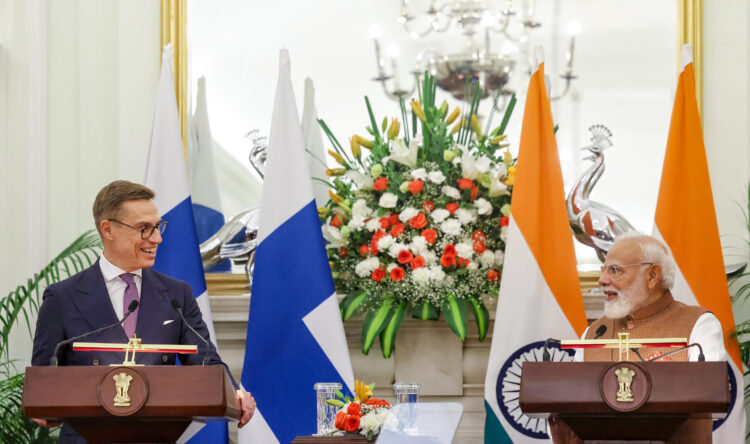
New Delhi: India-Finland bilateral trade rose 19 per cent in April–December (FY26) compared to the same period last year, marking “a new phase of momentum and structural realignment”, a report said on Thursday amid Finnish President Alexander Stubb’s first official visit to the country.
The report from Rubix Data Sciences said that exports have been the key driver of the renewed momentum, rising at 11 per cent year on year in April–December of FY26.
“As both governments aim to double the trade volume, the current presidential visit could serve as a catalyst to convert diplomatic intent into sustained economic scale,” the report said.
India’s outbound shipments to Finland increased from $300 million in FY22 to $600 million in FY24. Imports, which had remained largely stable at $800–900 million between FY22 and FY25, surged 24 per cent YoY in the same period, reflecting stronger demand for Finnish industrial and technology inputs, the report mentioned.
India’s trade deficit with Finland has narrowed to $300–400 million in recent years, creating a more balanced position.
The report highlighted a sharp structural shift in India’s export basket, with heterocyclic compounds jumping from 1 per cent to 28 per cent, emerging as the single largest export category. Passenger and cargo vessels rose to 10 per cent, and pharma products moderated from 18 per cent to 12 per cent.
On the import side, nitrogen fertilisers, though still dominant, declined from 28 per cent to 19 per cent, reducing commodity concentration. Electronic integrated circuits held steady at 15 per cent, while electrical transformers increased from 3 per cent to 5 per cent.
Chemical wood pulp expanded from 1 per cent to 4 per cent, underscoring growing industrial linkages.
Finland currently accounts for just 1 per cent of India’s total goods trade with the European Union.
“However, the 19 per cent trade expansion in FY26 and the narrowing deficit suggest that the relationship is becoming more technology-driven, more balanced, and more strategically aligned,” the report noted.
(IANS)