
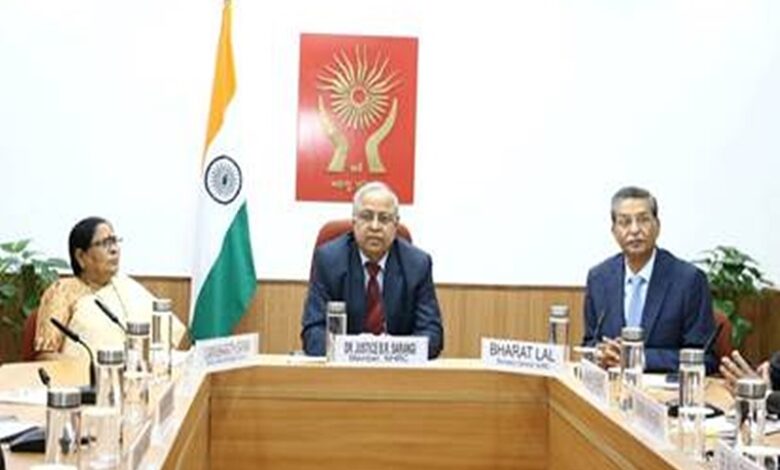
New Delhi: National Human Rights Commission (NHRC) Member Justice (Dr.) Bidyut Ranjan Sarangi said on Thursday that a growing threat posed by spurious medicines demands coordinated, multi-sectoral action to address this grave issue of human rights violation.
He was speaking at an Open House Discussion (OHD) in hybrid mode on the theme ‘Measures to Curb Spurious Medicines in India’ at NHRC premises in Delhi.
Justice Sarangi said that in a country as vast and diverse as India, even isolated regulatory challenges can translate into large-scale human distress if not addressed decisively and systematically.
Others who participated in the event included NHRC Member Vijaya Bharathi Sayani; Former Member, NHRC, Rajiv Jain; Secretary General Bharat Lal; Director General (Investigation) Anupama Nilekar Chandra; Registrar (Law) Joginder Singh; Joint Secretaries Samir Kumar, Saidingpuii Chhakchhuak and senior government functionarie.
Sayani reflected on the human cost of substandard treatment.
She recalled how a member of her family suffered permanent loss of eyesight due to improper treatment and the use of poor-quality medicines.
She said that the issue requires to be urgently addressed by placing in place strengthened oversight and accountability mechanisms in the pharmaceutical ecosystem.
Former NHRC Member Rajiv Jain emphasised that to strengthen enforcement and deterrence, there is a need for establishing special drug courts for expeditious trial of the accused.
He suggest real-time drug testing mechanisms; mandatory QR codes and track-and-trace systems and including blockchain-based supply chain authentication.
He also stressed upon compulsory use of NABL-accredited laboratories; AI-based anomaly detection in distribution patterns; surprise inspections; strengthened whistle-blower protection; digital case tracking; creation of a centralised national database on spurious drug cases; improved public helplines; and examination of regulatory safeguards concerning e-prescriptions.
NHRC Secretary General Bharat Lal said that both spurious and substandard medicines impact the right to life and health, calling for coordinated institutional action to combat the menace.
He emphasised that citizens consume medicines in good faith, trusting the state’s obligation to safeguard life and dignity and cautioned that any breach may result in violation of human rights of the victims.
Stressing that ‘medicines must heal, not harm,’ he also highlighted the clear distinction between ‘spurious drugs’ in different manifestations defined under Section 17-B of the Drugs and Cosmetics Act, 1940 and ‘substandard drugs’ (out-of-specification authorised products failing quality standards/specifications).
Citing the National Survey on Drugs, he noted that about 10 per cent of government samples were found substandard.
He said that spurious drugs are produced and distributed as part of criminal activity with no clearly identifiable manufacturer, which require criminal investigation, whereas manufacturers of substandard drugs can be traced.
He said that the NHRC has been very proactively taking suo motu cognizance of such reported incidents of rights violation due to alleged consumption of spurious medicines.
Keshav Kumar, Special Rapporteur, NHRC, who has undertaken extensive research on the subject, proposed enhanced monitoring, creation of central and state-level task forces, strengthening of regulatory compliance, improved inter-agency coordination, training of law enforcement and judicial officers, victim compensation mechanisms and collaboration with international bodies.
(IANS)