
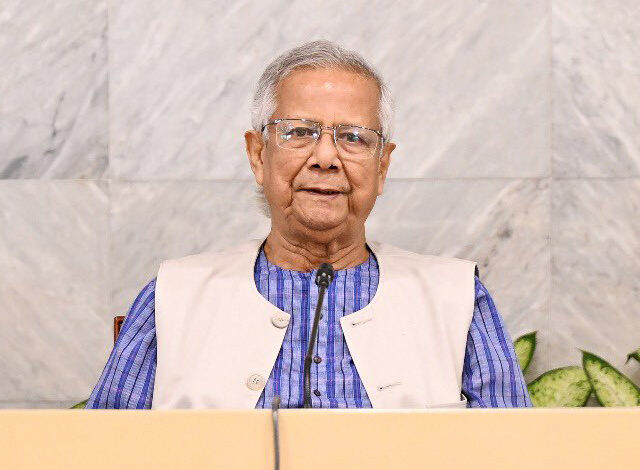
Dhaka: Business confidence weakened, industrial production slowed, and there were no significant new initiatives or major domestic or foreign investments in Bangladesh under the leadership of Muhammad Yunus who had taken over as the Chief Advisor of the interim government during a crucial period following the fall of government led by former Prime Minister Sheikh Hasina in August 2024, a report has highlighted.
According to renowned economist and former Vice-Chancellor of Jahangirnagar University, Professor Abdul Bayes, people expected Bangladesh’s economy to recover under Yunus. However, most economic indicators reportedly witnessed decline except remittance inflows and foreign exchange reserves.
“Business confidence weakened, industrial production slowed, and there were no significant new initiatives or major domestic or foreign investments. Meanwhile, unemployment and poverty increased. According to estimates cited from the World Bank, nearly three million people became newly poor during his tenure,” a report in Bangladesh’s leading newspaper ‘Daily Sun’ stated.
Yunus, popular for his famous vision of “sending poverty to the museum” by assuming the role of Chief Advisor of Bangladesh’s interim government had the opportunity to reduce poverty in the country. However, he was not able to utilise the opportunity effectively as an additional 30 lakh people reportedly fell into poverty during his tenure.
Citing experts, the newspaper reported that private sector investment reduced significantly under Yunus. In June 2024, the private sector investment was at 24 per cent of GDP, however, it reduced to 22.48 per cent by June 2025, a decline of nearly 1.5 percentage points in just one year. Public investment reached its lowest level in 10 years. According to the Centre for Policy Dialogue (CPD), implementation of the Annual Development Programme (ADP) between July-November reached 11.5 per cent.
Earlier this month, a leading US-based rights group Human Rights Watch (HRW) highlighted in its 2026 World Report that Yunus has also failed to maintain law and order and deliver on promised human rights reforms in Bangladesh
The HRW stated that the interim government arbitrarily detained thousands of perceived political opponents and, in May, banned the Awami League.
It also noted that the interim government decided to prosecute the most serious crimes allegedly committed during the Awami League’s tenure at Bangladesh’s International Crimes Tribunal (ICT), a domestic court previously used to prosecute crimes under international law committed during the country’s 1971 war of independence.
In November last year, the ICT sentenced Hasina, along with former Home Minister Asaduzzaman Khan Kamal, to death following trials in absentia for crimes against humanity. A former police chief, who is in custody, testified for the prosecution and was jailed for five years.
“The tribunal had been fraught with violations of fair trial standards, and while the interim government amended the law that establishes the court, introducing some improvements, it still lacks important due process protections and includes the death penalty, in violation of international human rights law. The interim government also gave the tribunal broad powers to prosecute and dismantle political organisations,” the HRW stated.
According to the rights group, one of the key challenges faced by the interim government was an alarming surge in mob violence by political parties and other non-state groups, including religious hardliners hostile to women’s rights and to lesbian, gay, bisexual, and transgender people.
(IANS)