‘Wholly Unable To Survive Judicial Scrutiny’: Delhi Court Discharges Kejriwal, Sisodia In Liquor Policy Case

New Delhi: A Delhi court on Friday discharged all 23 accused, including AAP national convenor Arvind Kejriwal and former Deputy Chief Minister Manish Sisodia, in the excise policy case being investigated by the Central Bureau of Investigation (CBI), holding that the prosecution failed to establish even a prima facie case or raise a “grave suspicion” warranting the framing of charges.
In a detailed order running into more than 1,100 paragraphs, Special Judge (PC Act) Jitendra Singh of the Rouse Avenue Court said that the case projected by the CBI was “wholly unable to survive judicial scrutiny” and stood “discredited in its entirety”.
“Upon an exhaustive and painstaking examination of the entire record, undertaken over a period exceeding two months, encompassing voluminous documentary material and the depositions of nearly three hundred prosecution witnesses, and after affording full opportunity of hearing to the parties, this Court is left in no manner of doubt that the prosecution case does not disclose even the threshold of a prima facie suspicion, far less the ‘grave suspicion’ mandated by settling principles of criminal jurisprudence for proceeding further,” the court held.
The Special Judge observed that compelling the accused to undergo a full-fledged trial in the absence of legally admissible material would amount to a “manifest miscarriage of justice and an abuse of the criminal process”.
The case pertained to the Delhi Excise Policy 2021–22 introduced by the AAP-led city government in November 2021, which was later scrapped in 2022 amid allegations of corruption, kickbacks and policy manipulation.
The CBI had alleged that the policy was tailored to benefit certain private liquor entities, including the “South Group”, in exchange for alleged upfront bribes that were purportedly routed for electoral purposes, including the Goa Assembly elections.
However, the court, after an “exhaustive and painstaking examination” of the voluminous record and depositions of nearly 300 prosecution witnesses, concluded that the “theory of an overarching conspiracy” had been “completely dismantled” when tested against the evidentiary record.
“The prosecution has failed to place any material which, even prima facie, suggests that the DEP-21/22 was manipulated, altered, or engineered to confer any undue or unlawful benefit,” the court held, adding that the contemporaneous record demonstrated that the policy was the outcome of a “consultative and deliberative exercise” undertaken after engagement with stakeholders and in adherence to the procedure prescribed under law.
“Once the formulation of the policy is shown to be the product of deliberation, institutional scrutiny, and procedural compliance, any subsequent attempt to attribute criminality to its implementation becomes wholly untenable,” the order said.
The court also rejected allegations relating to the payment and recoupment of “upfront money”, holding that the alleged chain of payments rested predominantly on “so-called pauti entries of Angadia firms, documents which are inadmissible in law, and on approver-like statement which remains uncorroborated on material particulars.”
“These infirmities are not peripheral; they strike at the very root of the prosecution case and render it unsustainable even at the threshold stage,” the order stated.
“The investigation appears to have proceeded on a predetermined trajectory, implicating virtually every person associated with the formulation or implementation of the policy in order to lend an illusion of depth and credibility to an otherwise fragile narrative,” it added.
The Special Judge expressed serious concern over the manner of investigation, particularly the repeated recording of statements of an approver after grant of pardon. It observed that such a practice risked converting the extraordinary mechanism of pardon into “an instrument for narrative construction rather than truth discovery.”
“If left unchecked, such conduct risks converting the exceptional mechanism of pardon into an instrument for narrative construction rather than truth discovery, thereby causing serious prejudice to the accused and eroding confidence in the criminal justice process,” the court said.
The court also disapproved of the repeated use of the expression “South Group” in the charge sheets, remarking that identity-based or region-based labelling “serves no legitimate investigative or prosecutorial purpose” and risks creating a prejudicial impression.
Such nomenclature, it said, “finds no foundation in law” and is “wholly alien to the statutory framework governing criminal liability” and “constitutes a constitutional infirmity capable of undermining the fairness of the proceedings themselves”.
“Region-based labelling carries an avoidable undertone and is capable of creating a prejudicial impression,” the order said, adding that criminal trials “must be about what the defendant did, not who the defendant is”.
The order also flagged broader constitutional concerns regarding prosecutions by the Enforcement Directorate (ED), noting that the offence of money laundering is inextricably linked to the survival of the predicate offence.
Relying on the Supreme Court’s ruling in the Vijay Madanlal Choudhary v. Union of India case, the court reiterated that if the scheduled offence does not survive, the Prevention of Money Laundering Act (PMLA) proceedings cannot independently subsist .
“The offence under the PMLA is thus not autonomous in its origin, but is inextricably linked to the existence of a legally sustainable scheduled offence. The predicate offence constitutes the foundational edifice upon which the allegation of money laundering rests; if the foundation crumbles, the superstructure must necessarily fall,” the order said.
The court warned that prolonged pre-trial incarceration on the basis of provisional and untested allegations risks turning the process itself into punishment, contrary to the mandate of Article 21 of the Constitution.
“Liberty, once curtailed, cannot be meaningfully restored by a subsequent acquittal, nor can the passage of time compensate for the loss occasioned by unwarranted pre-trial detention,” it said.
“Accordingly, Accused Nos. A-1 to A-23 are discharged of all the offences alleged against them in the present case,” the order concluded.
The discharge order brought unprecedented relief to the Aam Aadmi Party (AAP) leadership, as both Kejriwal and Sisodia had earlier been arrested in connection with the liquor policy investigation but were granted bail by the Supreme Court in 2024.
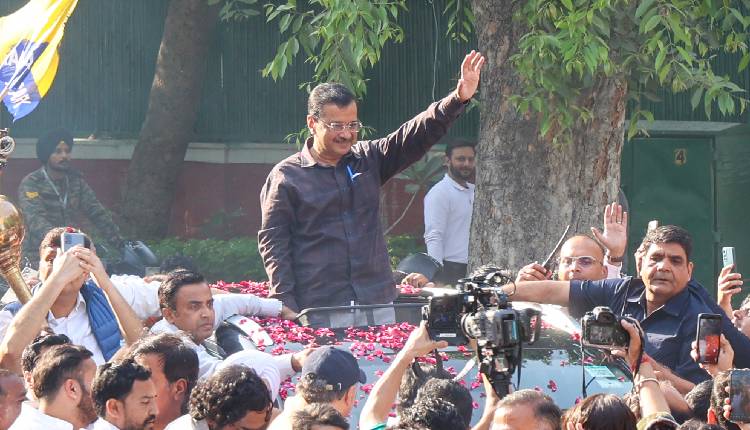
Soon after the order, Kejriwal said, “Satyamev Jayate”, reiterating his faith in the justice system. Visibly emotional, he recalled the period of incarceration and alleged that the case was “false and fabricated”.
Sisodia, standing beside him, was seen consoling the AAP chief as supporters gathered outside. However, the legal battle is far from over.
The CBI said it would challenge the discharge order before the Delhi High Court, asserting that several aspects of the investigation were either ignored or not adequately considered by the trial court.
With the CBI now set to file a revision petition, the high-profile case that once dominated national political discourse appears set to enter its next legal chapter.
(IANS)