
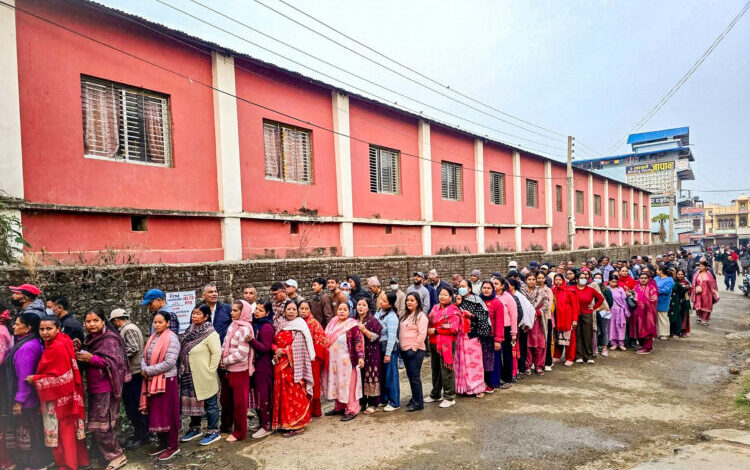
Kathmandu: Parliamentary elections in Nepal, which concluded in a largely peaceful environment on Thursday, recorded a relatively lower voter turnout.
Acting Chief Election Commissioner Ram Prasad Bhandari said at a press briefing that voter turnout is estimated to be around 60 per cent, based on preliminary details received from across the country.
If the turnout does not increase once the final data becomes available, it will be the lowest voter turnout since the parliamentary elections held in 1991. In 2022 elections, voters’ turnout was 61.41 per cent.
“The collection of detailed data is still ongoing. Information has been received from the concerned constituencies that in some polling centres, voting is still continuing as voters who had entered the polling stations within the designated time are casting their ballots,” he added.
He also said that, except for a few isolated incidents of obstruction, the election was conducted peacefully, according to preliminary reports from national and international election observers deployed to monitor the polls.
“With the completion of the voting process, vote counting will begin immediately after the ballot boxes are safely collected,” he said.
The Election Commission said ballot boxes from remote areas in 15 districts will be transported by helicopter.
According to the Commission, there are 18.9 million registered voters in the country. In some polling stations, people even boycotted the elections, expressing dissatisfaction over the government’s failure to deliver development.
“It is not dissatisfaction with the Election Commission, but with the government, and the government should look into it,” Bhandari said.
Fresh elections in the Himalayan nation were held nearly two years ahead of schedule due to the new political situation that emerged after the Gen-Z movement in September last year, which brought down the government led by former Prime Minister K P Sharma Oli. The development paved the way for the formation of the current interim government led by Sushila Karki.
Following her appointment as head of the government, the lower house was dissolved at the demand of Gen-Z leaders, and she was mandated to hold fresh elections within six months.
More than 18.9 million people are eligible to vote in these elections, including 915,119 newly registered voters. Of the total voters, more than two-thirds of the newly registered voters belong to the Gen-Z age group, marking a noticeable surge in youth engagement ahead of the 2026 polls, according to the Election Commission of Nepal.
The elections were held at 23,112 polling centres. A total of 3,406 candidates are in the race under the First-Past-the-Post (FPTP) system, while 3,135 candidates are contesting under the proportional representation system.
(IANS)