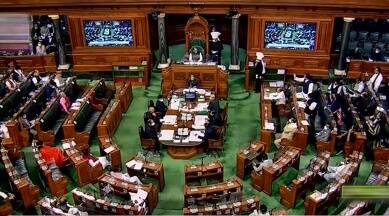

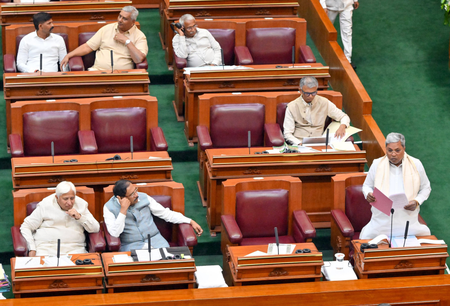
Belagavi, Dec 19 : Karnataka Chief Minister Siddaramaiah stated on Friday that open defecation, child marriage and child pregnancies persist in the North Karnataka region despite schemes and reforms.
“The MLA from our Jewargi constituency is demanding the construction of boundary walls to prevent women from going out in the open for defecation. I asked him whether toilets already exist. He replied that people do not use them. What can one say to this?” informed Siddaramaiah the Assembly while replying to issues raised by North Karnataka by ruling and opposition leaders.
The Chief Minister stated that the government has allocated funds to construct toilets, noting that under the Jal Jeevan Mission, taps have been installed and a water supply is being provided.
“Yet, people are still not using the toilets. How do we address this problem? These are not simple issues, and we must find solutions to them,” he stated.
The Chief Minister said that there are laws prohibiting child marriage, with strict punishments prescribed, adding that despite this, marriages are conducted by evading the entire administrative machinery.
“As a result, the number of child pregnancies is increasing. Children born to adolescent mothers face serious malnutrition-related problems. Even though people are aware of all this, such practices continue. That is why, every time I hold meetings with deputy commissioners and CEOs, I repeatedly raise this issue and instruct them to prevent it strictly,” he said.
The Chief Minister informed that in a rigid caste-based society, economic and social empowerment is essential to remove stagnation.
He said that before Independence, literacy stood at 10-12 per cent, but today it is at 76 per cent, yet the caste system persists.
“Even doctors believe in fate and the theory of karma. Due to the caste system, a mindset of servitude has taken root in society. It is to address this that guarantee schemes have been implemented,” the Chief Minister said.
He further noted that low milk production in the six districts of Kalyana Karnataka is one of the reasons for low per capita income in the region.
“Kalaburagi ranks as the most backward district in terms of per capita income. Despite the allocation of funds, why has development not taken place?” he said.
He also claimed that the earlier UPA government had intended to effectively implement the Nirmal Bharat Abhiyan.
“In the 2013-14 budget itself, Rs 4,260 crore was allocated for the scheme. By 2013, toilets had been constructed in around 38 to 40 per cent of rural households. Prime Minister Narendra Modi later renamed the Nirmal Bharat Abhiyan as the Swachh Bharat Mission,” he said.
The Chief Minister said that reports state that by 2019-20, toilets had been constructed in nearly 90 per cent of households.
He said that several opposition leaders, among others, referred to per capita income.
“Compared to other parts of the state, the per capita income of people in the Kalyana Karnataka districts is lower. The latest comprehensive per capita income data available is for the year 2023-24,” he said.
He said that based on this data, the state’s average per capita income at current prices stands at Rs 3,39,813.
“There are six districts where per capita income is higher than this average: Bengaluru Urban, Mangaluru, Udupi, Chikkamagaluru, Bengaluru Rural and Shivamogga, where per capita income exceeds Rs 3.4 lakh,” he said.
The Chief Minister said that 10 districts fall close to this range, with per capita income between Rs 2.5 lakh and Rs 3.4 lakh, adding that these are Mandya, Tumakuru, Kodagu, Hassan, Ballari, Ramanagara, Karwar, Dharwad, Chamarajanagar and Bagalkot, he stated.
He said that four districts fall in the Rs 2 lakh to Rs 2.5 lakh per capita income bracket. “They are Mysuru, Chikkaballapur, Kolar and Davanagere. There are 11 districts where the per capita income is below Rs 2 lakh. These include Chitradurga, Gadag, Haveri, Raichur, Vijayanagara, Vijayapura, Bidar, Belagavi, Koppal, Yadgir and Kalaburagi,” he said.
The Chief Minister said that the government needs to focus more on improving districts that fall into the fourth group.
“Out of the 14 districts of North Karnataka, 10 districts, along with Chitradurga, fall into this category. The per capita income of Mysuru, Kolar, Chikkaballapur and Davanagere districts in the south and central is also close to that of the fourth group,” he said.
He said that even so, when we examine why per capita income is low in 10 districts of North Karnataka, particularly in Kalyana Karnataka, it becomes evident that wherever dairy activities are weak, per capita income is also low.
IANS